
When Households Trade Down, Commodity Orders Change
Rising retail revenues can conceal a market in retreat. For commodity traders, the more revealing signals are often found in the cuts, packaging specifications and credit terms of the next purchase order.
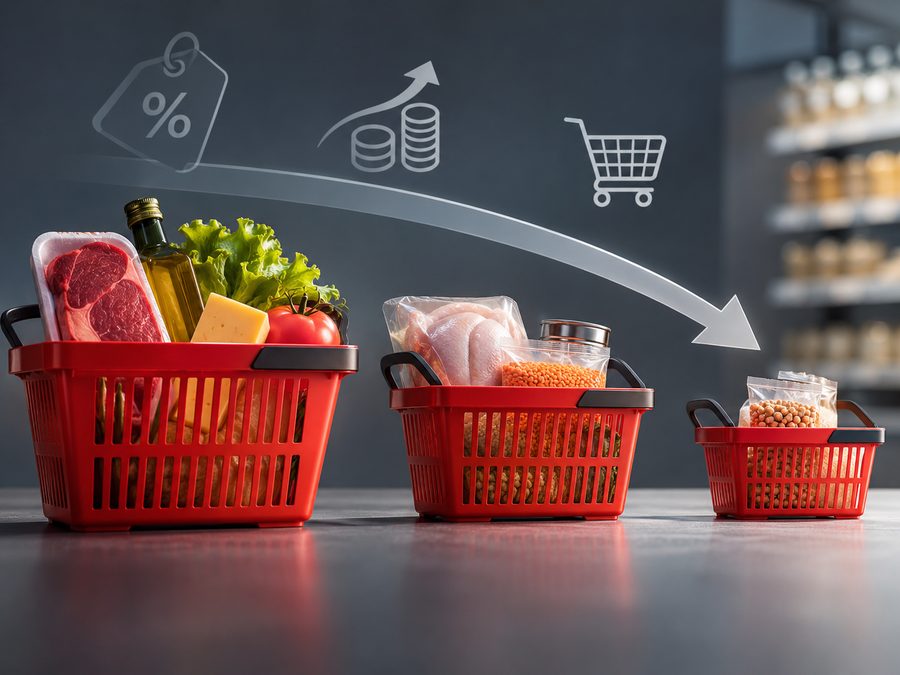
German retail sales rose 1.2% in cash terms in September 2026 but fell 2.3% after adjusting for prices: rising revenue can hide falling volume. Under pressure, households trade down before they stop buying, so the change reaches the purchase order first, in cheaper cuts, smaller packs, different proteins and longer credit. Import policy is part of the picture: India's duty-free pigeon peas and black gram against a 30% duty on yellow peas can separate the landed cost of two cargoes that look alike at origin.
German retailers took in 1.2% more money in September 2026 than they had a year earlier. Strip out the effect of inflation, however, and sales fell by 2.3%.
Both figures came from the same statistical release, yet they tell markedly different commercial stories. For an importer committing capital to a shipment months before it reaches the shelf, the distinction is consequential. A market that appears to be expanding can leave a distributor holding inventory that consumers are increasingly unwilling, or unable, to afford.
The international food market offers little clarity. The FAO Food Price Index declined by 1.2% in October 2026 but remained 5.9% above its level a year earlier. Sugar prices rose for a fourth consecutive month, while rice gained 1.6%.
An easing global index does not necessarily translate into relief at the supermarket. Between the international commodity market and the household shopping basket lie freight charges, exchange rates, import duties, distribution costs and retail margins. Each can dilute or delay the benefit of falling wholesale prices.
For traders, the question is no longer simply whether consumers are buying less. It is what they are buying instead.
The changing economics of the shopping basket
Food is among the last expenses households can eliminate. When incomes fail to keep pace with prices, consumers tend to adjust their choices before abandoning a category altogether. Premium cuts give way to cheaper ones, familiar brands lose ground to affordable alternatives, and the size of the weekly shopping basket begins to shrink.
Consider the American beef market. The United States entered 2026 with approximately 86.2 million cattle and calves, its smallest January inventory since 1951. Restricted supply has kept beef prices near historic highs.
A household that once regularly purchased premium beef might settle for a cheaper cut this week and substitute chicken the next. At the retail level, these appear to be separate purchasing decisions. Further upstream, they can reshape demand across two commodity markets.
A meat importer may find that premium specifications are becoming harder to sell, while a poultry distributor encounters stronger demand for particular portions. Neither development necessarily means that the market for animal protein has collapsed. Its composition has changed.
The distinction matters because purchasing programmes built around historical demand can become commercially obsolete long before their contracts expire.
The trade-down effect
The consequences of declining purchasing power differ considerably across product categories. For suppliers, recognising those differences is essential to protecting both sales and margins.
| Commodity | Commercial shift | Implications for traders |
|---|---|---|
| Red meat | Substitution towards affordable cuts and grades | Reassess product specifications and premium inventory exposure. |
| Poultry | Greater demand for competitively priced portions | Adjust product mix and shipment allocation. |
| Pulses | Increased emphasis on affordable retail pack sizes | Review packaging formats, processing and distribution costs. |
| Grains | Greater pressure on margins and working capital | Recalculate financing costs and credit exposure. |
These shifts do not follow a universal sequence. Relative prices, dietary preferences and local distribution networks determine how consumers respond.
A cheaper protein in one country may remain comparatively expensive in another. A smaller retail pack may attract price-sensitive consumers while increasing packaging costs for the supplier.
What matters is identifying where the commercial value has moved, rather than assuming that yesterday's purchasing patterns will survive tomorrow's prices.
When household budgets reach the tariff schedule
The consequences extend beyond retail behaviour. In markets where food affordability is politically sensitive, governments can respond through trade policy, sometimes altering the economics of an entire shipment.
India illustrates the point. Duty-free imports of pigeon peas and black gram were extended through March 2027 as part of efforts to contain domestic pulse prices. Yellow peas remained eligible for free import without a minimum import price, but continued to attract a 30% duty.
Two cargoes that appear competitive at their respective loading ports can therefore arrive in the Indian market with markedly different landed costs.
For international suppliers, monitoring agricultural production and commodity quotations is insufficient. Import policy has become an integral part of commercial intelligence, particularly in markets where household expenditure influences government intervention.
The cheapest product at origin is not necessarily the most competitive product at destination.

The order that looks unchanged
One of the more easily overlooked manifestations of consumer trade-down is a purchase order whose total volume remains unchanged.
A distributor may still require the same tonnage but request smaller retail packs. Reducing the contents of a bag allows retailers to preserve an accessible shelf price, even when the price per kilogram has increased.
For the supplier, however, the commercial calculation changes. Packaging materials, handling requirements and processing costs can rise without a corresponding increase in the quoted commodity price.
Payment terms deserve similar scrutiny.
A buyer requesting an additional month of credit may be experiencing slower inventory turnover, higher financing costs or broader liquidity constraints. Such a request is not, by itself, evidence of weakening consumer demand. It does, however, warrant a closer examination of how quickly the buyer is converting inventory into cash.
An unchanged price per tonne offers little protection if the transaction takes longer to finance and carries greater credit risk.
Five signals worth watching
| Market signal | What to examine |
|---|---|
| Category-specific food inflation | Price movements in the products consumers actually purchase, rather than headline inflation alone. |
| Shrinking retail packs | Changes in package weight, shelf price and price per kilogram. |
| Import policy adjustments | Applicable duties, effective dates and shipment eligibility. |
| Changing product specifications | Differences in grades, cuts and packaging across successive orders. |
| Extended payment terms | Requested credit periods, actual settlement behaviour and inventory turnover. |
Individually, these indicators can have several explanations. Examined together, they can reveal a changing market before the shift becomes apparent in aggregate import volumes.
Before renewing a supply agreement, traders should look beyond the previous shipment's tonnage. They need to understand what is selling, at what price, in which format and how quickly.
That information may justify a change in packaging rather than a reduction in price. It may favour a different grade, a different protein or a more carefully structured payment schedule.
The distinction between falling demand and shifting demand is becoming increasingly valuable in international commodity trade. Suppliers who confuse the two risk discounting products that no longer match the market, while overlooking opportunities that remain commercially viable.
The demand may still be in the same store, one shelf over.
This article appears in CARAVAN, Issue 11, December 2026.
- Cash sales can rise while real volume falls: read volume, not revenue.
- Trade-down moves demand between cuts, grades, proteins and pack sizes before it cuts total demand.
- An unchanged tonnage can hide smaller packs and higher packing and handling costs.
- A request for longer credit is a reason to check how fast the buyer turns stock into cash.
- Read five signals together: category inflation, pack sizes, import policy, specifications and payment terms.

Rami Ahmed Hassan
Senior IT Specialist · Business Consultant · Writer & Editorial Contributor, Qasr Al Anqaa
He writes for CARAVAN on how technology and AI are changing deal-making, risk and trade policy.
Sources & References
Sources the figures in this article are attributed to.
- Meininger / Destatis — German retail sales, September 2026For: German retail sales up 1.2% in cash terms and down 2.3% after adjusting for prices, year on year
- Bloomberg — US cattle herd stays at 75-year lowFor: about 86.2 million US cattle and calves in January 2026, the smallest January inventory since 1951
- Food Ingredients First — FAO Food Price Index, October 2026For: FAO index down 1.2% in October 2026 and 5.9% above a year earlier; sugar up for a fourth month
- Agriland — FAO: rice index up 1.6% in OctoberFor: rice prices up 1.6%
- Reuters via AJOT — India's pulse import dutiesFor: duty-free pigeon peas and black gram to March 2027; 30% duty on yellow peas