
Pulses Market 2026: Five Commodities, Five Markets
India’s selective import duties, China’s renewed appetite for Canadian peas and Dubai’s evolving distribution role are redrawing the economics of the global pulses trade. For merchants preparing for 2027, understanding these shifts requires looking well beyond the harvest.
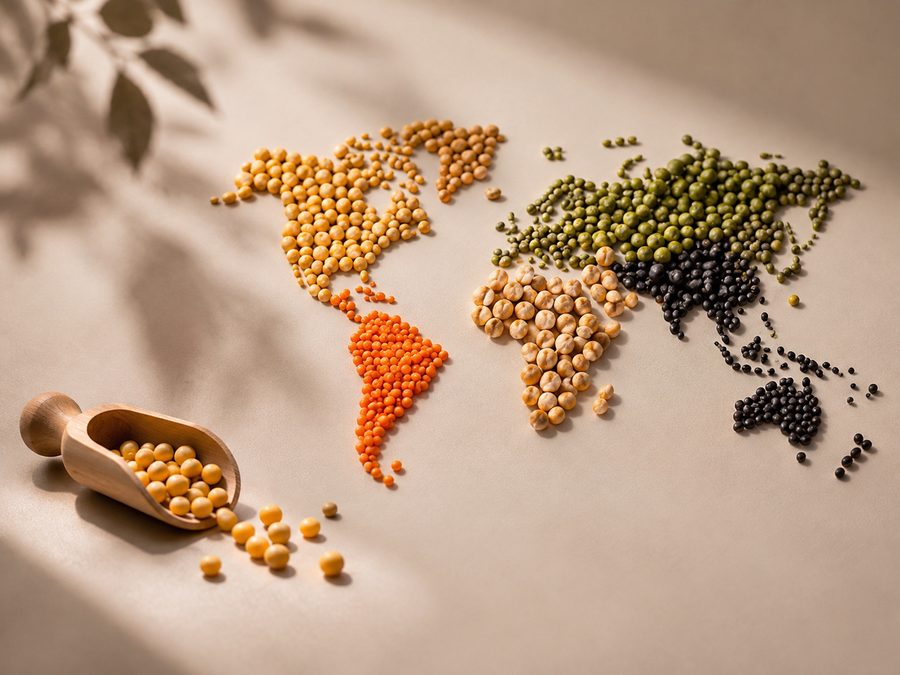
Yellow peas, lentils, chickpeas, pigeon peas and black gram serve different buyers and react to different policies. India charges a 30% duty on yellow peas while pigeon peas and black gram stay duty-free until March 31, 2027; China has extended its relief on Canadian peas to the end of 2028; Canada's lentil crop fell 26.6%, but total supply only about 3.7%. Dubai's value lies in what happens after arrival, and a contract's crop year, grade and bill-of-lading date decide whether a cheaper tonne stays cheaper.
A Canadian exporter can secure a competitive purchase price, charter a vessel and find that the economics of the shipment have changed before it reaches its destination. In the international pulses trade, the commercial life of a cargo is increasingly shaped by decisions made thousands of miles from the farm.
Few markets demonstrated this more clearly in 2026 than India. Changes to import duties and access conditions altered the relative attractiveness of competing commodities, forcing exporters to reconsider destinations and buyers to reassess procurement strategies.
The industry has long grouped yellow peas, lentils, chickpeas, pigeon peas and black gram under a convenient commercial heading. That classification is useful for customs statistics and agricultural reporting. It offers considerably less guidance when negotiating a shipment.
Each commodity serves a different customer base, responds to different supply pressures and carries its own exposure to government intervention. Understanding those distinctions will be essential for anyone trading pulses in 2027.
Five Commodities, Five Commercial Realities
| Commodity | Principal export origins | Major buying markets | Primary demand |
|---|---|---|---|
| Yellow peas | Canada, Russia | China, India | Starch, protein and food processing |
| Lentils | Canada, Australia | India, Türkiye, UAE | Household consumption and dal |
| Chickpeas | Australia, Russia, Argentina | South Asia, Middle East | Direct food consumption |
| Pigeon peas | Myanmar, East Africa | India | Dal |
| Black gram | Myanmar, Brazil | India | Dal and traditional foods |
Yellow peas are increasingly finding buyers outside traditional food markets. Industrial applications, including starch extraction and plant-based protein production, have introduced a different set of demand drivers, particularly in China.
Lentils remain more closely tied to household purchasing power. Food inflation, domestic harvests and the affordability of alternative proteins influence how much consumers buy and, ultimately, how aggressively importers replenish stocks.
Chickpeas occupy two distinct commercial segments. Larger kabuli varieties serve Mediterranean and Middle Eastern consumers, while smaller desi chickpeas remain deeply embedded in South Asian diets.
For pigeon peas and black gram, the geography of demand is considerably narrower. India's dominance leaves suppliers in Myanmar, East Africa and other producing regions particularly exposed to changes in its agricultural and import policies.
These differences explain why an abundant harvest in one segment may offer little relief to buyers facing shortages in another.
New Delhi's Influence Extends Beyond India's Borders
India's approach to pulses imports has become increasingly selective. Policymakers must balance the interests of domestic farmers against food affordability, stock availability and the risk of shortages.
The resulting tariff structure reflects those competing priorities.
| Commodity | Indian import duty | Policy status |
|---|---|---|
| Yellow peas | 30% | Effective November 1, 2025; free-import classification without a minimum import price extended to March 31, 2027 |
| Red lentils | 10% | Under review, according to Reuters reporting |
| Chickpeas | 10% | Under review, according to Reuters reporting |
| Pigeon peas | Duty-free | Until March 31, 2027 |
| Black gram | Duty-free | Until March 31, 2027 |
India imported approximately 6.7 million tonnes of pulses in 2024, including around 3 million tonnes of yellow peas. The subsequent introduction of a 30% duty substantially changed the landed-cost calculation for overseas suppliers accustomed to more favourable access.
The distinction between commodities is revealing. Pigeon peas and black gram retain duty-free access amid constrained domestic availability, while yellow peas face higher protection because of their competition with India's domestic chana crop.
Import liberalisation should not be confused with tariff exemption. A commodity may remain freely importable without quantitative restrictions or a minimum import price while still attracting customs duties.
For procurement teams, March 31, 2027, is therefore an important planning date. Purchase commitments, shipment schedules and contractual exposure need to be assessed against the possibility of another policy adjustment.
A favourable quotation today offers limited protection against a higher landed cost tomorrow.
China Gives Canadian Peas a Second Opening
China's renewed access for Canadian peas represents another significant development in the 2026 market.
After imposing a 100% tariff in March 2025, Beijing suspended the measure in 2026 and agreed in November to extend the relief through the end of 2028. The arrangement also advances market access for Canadian faba beans, chickpeas and lentils.
The speed of the recovery illustrates the commercial importance of China to Canadian agriculture. Between March and September 2026, Canada shipped approximately 975,000 tonnes of peas to China, valued at C$421 million.
For growers and exporters, the longer tariff-relief period offers greater visibility when making planting, storage and forward-sales decisions.
Access for processed products, however, remains more complicated. A reported 73.5% duty on Canadian pea starch creates a markedly different commercial environment for processors than for exporters of raw peas.
The consequences extend beyond shipment volumes. Tariff differences between raw agricultural commodities and processed ingredients can influence where companies invest in manufacturing capacity and where the higher-value stages of the supply chain take place.
Canada's Smaller Lentil Harvest Is Only Part of the Story
Canadian lentil production declined sharply in the 2026/27 season, falling to 2.47 million tonnes from 3.36 million tonnes a year earlier.
The production figure alone suggests a considerably tighter market. Large carry-in stocks, however, are expected to limit the decline in total available supply to approximately 3.7%. Australia's anticipated large harvest introduces additional competition, particularly in red lentils.
Export patterns offer further evidence of a fragmented market.
During January–September 2026, the value of Canadian lentil exports increased by 18.1%. Shipments to India rose by 127.2%, while those to the UAE fell by 40.1%.
For traders, these divergent movements are a reminder that a national production forecast provides only part of the information needed to make a procurement decision. Availability, destination-specific demand and competing origins must be considered together.
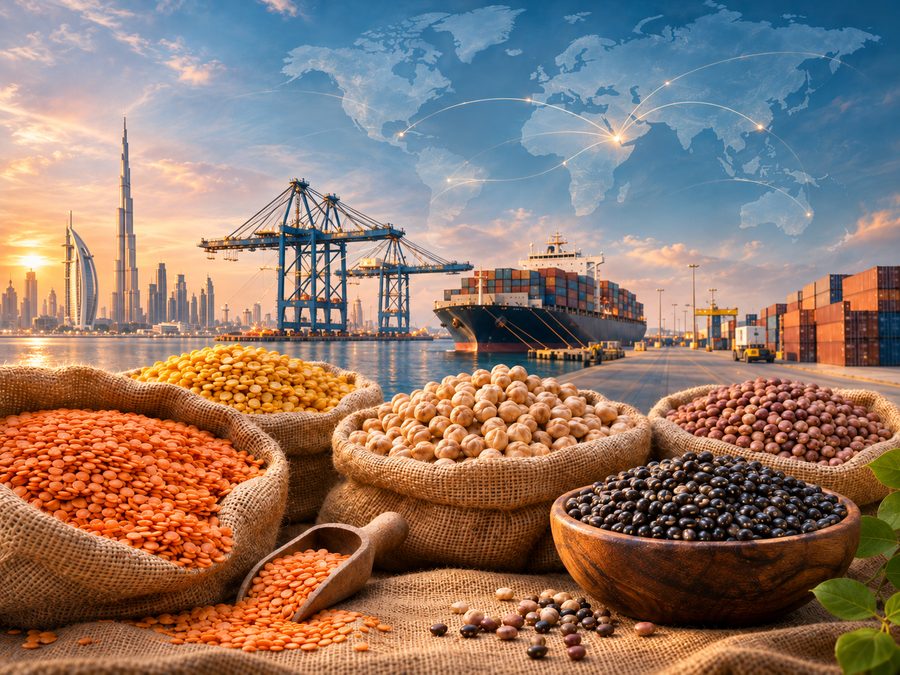
Dubai's Advantage Lies in What Happens After Arrival
Dubai has built its position in the pulses trade without producing the commodity itself.
Its commercial advantage lies in the infrastructure surrounding the shipment: ports, warehouses, processing facilities, packaging operations, distribution networks and access to multiple consuming markets.
A distributor holding inventory near Jebel Ali can serve customers across the Gulf, South Asia and East Africa, adjusting allocations as orders arrive. For businesses operating across several destinations, that flexibility can justify purchasing through a regional distribution hub rather than arranging separate shipments directly from producers.
The economics become more attractive when bulk commodities can be cleaned, dehulled, split, graded or repackaged to meet the requirements of different buyers.
Yet maintaining that flexibility requires capital.
Warehousing, inventory financing, handling and processing all add to the cost of a commodity that often trades on narrow margins. The decline in Canadian lentil shipments to the UAE during 2026 also serves as a reminder that established trading hubs cannot take their volumes for granted.
Dubai's long-term competitiveness will depend on how efficiently its merchants turn geographical access into measurable commercial value.
Where Procurement Margins Are Won or Lost
The quality of a pulses transaction is frequently determined before the cargo is loaded.
A purchase order describing the product simply as “Canadian red lentils” leaves considerable room for interpretation. Differences in crop year, moisture, grain size and processing quality can affect both the resale value and the suitability of the shipment for its intended market.
An illustrative purchase specification might include the following:
| Contract field | Illustrative specification |
|---|---|
| Product | Whole red lentils, No. 2 Canada Red |
| Origin | Canada |
| Crop year | 2026 |
| Grain size | Target 4.0–5.5 mm, subject to confirmation |
| Moisture | Maximum 13% |
| Foreign matter | Maximum 0.5% |
| Peeled, split and broken grains | Maximum 3.5% |
| Documentation | Phytosanitary certificate; fumigation certificate where required |
| Packaging | 50 kg food-grade polypropylene bags |
| Delivery | CFR Jebel Ali — Incoterms® 2020 |
| Inspection | Independent pre-shipment inspection |
Crop year deserves particular attention. Unless explicitly specified, a buyer may receive older inventory at a price negotiated on the assumption of a recent harvest.
Shipping dates carry an equally important commercial implication. India's yellow-pea import rules use the onboard bill of lading date to determine eligibility under relevant policy conditions. A delayed vessel can therefore expose a transaction to a different regulatory or tariff treatment.
These are matters for contract negotiation, rather than disputes to be resolved after arrival.
The Commercial Outlook for 2027
The coming year will reward merchants who develop a more granular understanding of the pulses trade.
An abundant supply of yellow peas cannot automatically compensate for a shortage of lentils. A strong chickpea harvest offers limited relief to consumers whose diets depend on pigeon peas. Industrial processors face different substitution constraints from households, and government policy can narrow the available choices further.
Crop forecasts will remain essential, but their commercial significance increasingly depends on import permissions, tariff structures, bilateral agreements and the cost of moving inventory between markets.
For buyers, the priority is to secure the right commodity, from the right origin, under contractual terms that account for regulatory uncertainty.
The most competitive purchase in 2027 may not be the shipment with the lowest initial quotation. It may be the one whose economics remain intact when the goods finally reach the buyer.
The purchase specification is illustrative and does not describe a QAA transaction. Incoterms® references follow ICC Incoterms® 2020. First published in CARAVAN, Volume 1, Issue 11 — December 2026.
- Treat pulses as five markets: a surplus in one rarely fixes a shortage in another.
- March 31, 2027 is the date to plan around for Indian pulse imports.
- China's relief on Canadian peas runs to the end of 2028; pea starch still faces a reported 73.5% duty.
- A 26.6% fall in Canada's lentil crop cuts total supply by only about 3.7%, thanks to carry-in stocks.
- Specify crop year, moisture, foreign matter and splits, and watch the onboard bill-of-lading date.

Amit Tata
International Sales Manager, Qasr Al Anqaa · Specialist Writer on Commodities & Trade
He writes on commodity supply chains, trade finance and market access for CARAVAN.
Sources & References
Sources the figures in this article are attributed to.
- Reuters via AJOT — India considers cutting import duties on pulsesFor: 10% duties on red lentils and chickpeas under review
- Down To Earth — Yellow peas import policy extended to March 2027For: free import of yellow peas without a minimum import price extended to March 31, 2027
- Khaleej Times — India imposes 30% duty on yellow peas from NovemberFor: 30% import duty on yellow peas from November 1, 2025
- Devdiscourse — Yellow peas' share of India's pulse importsFor: India imported about 6.7 million tonnes of pulses in 2024, including about 3 million tonnes of yellow peas
- Global Affairs Canada — Expanding trade between Canada and ChinaFor: China's suspension of the 100% tariff on Canadian peas, extended to the end of 2028
- Government of Saskatchewan — Canada–China market accessFor: market access for Canadian peas, faba beans, chickpeas and lentils in China
- Western Producer — China's duty on Canadian pea starchFor: reported 73.5% duty on Canadian pea starch
- UkrAgroConsult — Canada's lentil production falls 27%For: Canadian lentil crop down to 2.47 million tonnes in 2026/27 from 3.36 million
- UkrAgroConsult — India and Türkiye increase purchases of Canadian lentilsFor: Canadian lentil exports by destination, January–September 2026