
The Same Cargo. Two Routes. Two Prices.
Why a cheaper freight quote can produce a more expensive delivery
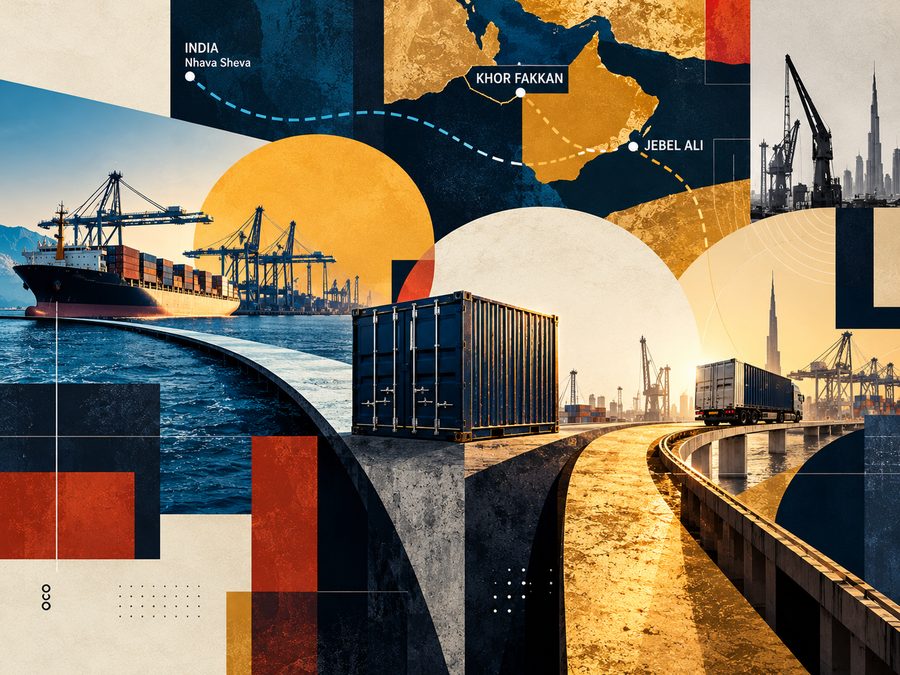
For a 20-foot container from Nhava Sheva to Dubai, published benchmarks put ocean freight via Khor Fakkan about $1,325 below the direct Jebel Ali service. Moving the box onward to Jebel Ali under bond cuts that gap to roughly $780, before terminal, bonded-transfer, documentation and delay charges are quoted. The article treats $780 as a decision threshold, not a saving, shows where it disappears, and explains why clearing at Khor Fakkan should also be priced.
A lower ocean-freight quote is not the same as a cheaper shipment. For a 20-foot container moving from India's Nhava Sheva port to a consignee in Dubai, the route through Khor Fakkan shows a striking discount at sea. Once the container is moved onward, however, the apparent saving falls to roughly $780—before several costs have even been quoted.
That $780 is the useful number. It is the margin within which extra terminal, bonded-transfer and administration charges must fit if the alternative route is to remain less expensive on the costs identified so far.
An ocean-freight discount with a much smaller margin
Published Cogoport benchmarks dated 23 October 2026 put indicative freight from Nhava Sheva to Khor Fakkan at approximately $3,917 per 20-foot container, against about $5,242 to Jebel Ali. At the vessel stage, Khor Fakkan is roughly $1,325 cheaper—around 25% less.
The comparison changes after discharge. Moving the container under bond from Khor Fakkan to Jebel Ali adds an estimated $545 using a trucking reference published in March 2026. On those inputs, the price gap narrows to about $780. It is an indicative transport-cost advantage, not a verified saving on the complete delivery.
The decision threshold: about $780 per 20ft container
What is actually being compared?
The example holds the cargo constant: one standard 20-foot dry container carrying non-hazardous merchandise, shipped from Nhava Sheva to the same Dubai consignee. Weight, value, product specification and final delivery requirements do not change. Only the routing and related logistics stages differ.
Route A | Direct to Jebel Ali
Nhava ShevaJebel AliCustoms clearanceFinal delivery
Route B | Via Khor Fakkan
Nhava ShevaKhor FakkanBonded truckingJebel AliCustoms clearanceFinal delivery
Dubai Trade introduced procedures in March 2026 for containers discharged at Khor Fakkan and Fujairah to move under bond to Jebel Ali. The precise movement remains subject to the shipping line, terminal and customs process.
Route C | Clear at Khor Fakkan
Nhava ShevaKhor FakkanCustoms clearanceDirect delivery to consignee
A third option deserves attention: customs clearance at Khor Fakkan followed by direct road delivery. Depending on the consignee's location—in Sharjah, northern Dubai or an industrial district along Emirates Road—this could avoid most of the backhaul to Jebel Ali. The article does not assign Route C a price: a destination-specific trucking and clearance quotation is needed before comparison.
The quoted costs—and the gaps between them
Illustrative comparison · USD per 20ft container
| Cost component | Route A · Direct | Route B · Via Khor Fakkan |
|---|---|---|
| Ocean freight | $5,242 | $3,917 |
| Inland transfer to Jebel Ali | — | ≈ $545 |
| Identified transport subtotal | ≈ $5,242 | ≈ $4,462 |
| Additional terminal handling | Quote required | Quote required |
| Bonded transfer | — | Quote required |
| Documentation / administration | Quote required | Quote required |
| Insurance / applicable surcharges | Quote required | Quote required |
| Storage / delay | Variable | Variable |
| Final landed cost | Not established | Not established |
Figures rounded to the nearest dollar. The Route B subtotal is calculated from the displayed rounded inputs. Ocean rates are October 2026 benchmarks; the trucking reference is from March 2026 (AED 2,000 at AED 3.6725/USD).
The road-haulage assumption requires particular care. TruKKer's AED 2,000 reference dates from 16 March, during a period of acute disruption; it is not an October firm quotation. If today's trucking is cheaper, Route B's margin could increase. If port queues and truck waiting times have raised prices, the remaining advantage could diminish further.
When the cheaper route stops being cheaper
An alternative-port quotation should be evaluated on its net extra costs relative to the direct service. Terminal handling, bonded processing, paperwork, container detention and storage all have the potential to absorb the initial discount. The figures below show how quickly that can happen.

| Additional net cost on Route B | Advantage remaining |
|---|---|
| $0 | +$780 |
| $250 | +$530 |
| $500 | +$280 |
| $780 | $0 |
| $1,000 | –$220 |
Illustrative net additions relative to Route A—not actual charges from a completed shipment. Costs common to both routes are excluded.
At $780 in additional net charges, the identified price advantage disappears. At $1,000, the Khor Fakkan option becomes about $220 more expensive on this limited cost basis. Neither result should be mistaken for a final landed-cost quotation.
Port congestion changes the delivery equation
The estimated ocean passage for either routing is broadly similar—approximately three to four days—but the vessel's arrival is not the consignee's delivery date. October operational guidance from Maersk flagged high yard utilisation, congestion and long truck waits at Khor Fakkan. Some movements may also pass through an inland container depot before proceeding onward.
Extra handovers create time and cost exposure. Applicable free time, container and truck availability, storage tariffs and customs scheduling can matter as much as the vessel's transit time. Without confirmed end-to-end arrangements, neither route has a reliable total delivery lead time.
Who carries the rerouting cost?
Commercial exposure also depends on the contract. Under FCA, the buyer generally arranges the main carriage. With DAP, the seller carries the transport obligation and risk to the named destination. Under CIF, the seller pays for the contracted carriage and insurance, while the risk of loss or damage normally transfers when the goods are loaded on board.
None of those rules, by itself, settles who must pay an unexpected rerouting surcharge. That turns on the agreed delivery point, the sales contract, carrier terms and the circumstances of the change. It should be addressed before the cargo moves, not after the invoice arrives.
Three cargoes, three different decisions
Time-sensitive freight
The strongest offer may be the one with a confirmed, dependable final-delivery schedule, even if its freight component is higher.
Low-margin trades
A residual cushion of $780 is thin when several charges remain unpriced. A small change in terminal or inland costs can turn the apparent advantage into a loss.
Delivery-critical projects
For cargo tied to a production or installation deadline, confirmed vessel space, terminal acceptance, bonded trucking and clearance may be worth more than an unverified ocean-rate discount.
What the numbers establish—and what they do not
On the observed benchmarks, routing through Khor Fakkan may provide cheaper ocean freight for this particular India–Dubai movement. The evidence does not establish that it produces a cheaper delivered container. That conclusion requires an all-in quote, validated handling arrangements and a workable delivery timetable.
A $780 differential is a decision threshold—not a confirmed saving.
Methodology: Research cut-off 25 October 2026. This is a published-benchmark comparison, not an executed shipment. The March truck estimate is historical; unquoted expenses are not treated as actual charges. Break-even figures are illustrative, values rounded, and Route C is not costed. A firm all-in quotation is required to establish landed cost.
- Ocean freight via Khor Fakkan was about $1,325 cheaper per 20ft container than to Jebel Ali on 23 October 2026 benchmarks.
- After an estimated $545 bonded truck move to Jebel Ali, the identified advantage falls to about $780.
- At $780 of extra net charges the advantage is gone; at $1,000 the Khor Fakkan route is about $220 dearer on this basis.
- Clearing at Khor Fakkan and delivering direct may avoid most of the backhaul, but needs its own quote before comparison.

Sahar Sayyad
Business Consultant · Writer & Editorial Contributor, Qasr Al Anqaa
She writes for CARAVAN on freight economics, routing decisions and landed cost.
Sources & References
Sources the figures in this article are attributed to.
- Cogoport — Indicative JNPT–Jebel Ali and JNPT–Khor Fakkan container-freight benchmarks — 23 October 2026For: ocean freight per 20ft container on both routes
- TruKKer — Published Khor Fakkan–Jebel Ali trucking reference — 16 March 2026For: AED 2,000 inland transfer estimate
- Dubai Trade — Alternative-port import and bonded transport arrangements — 7 and 15 March 2026For: bonded movement from Khor Fakkan and Fujairah to Jebel Ali
- Maersk — Regional operational updates on congestion, inland transfers and charges — October 2026For: yard utilisation, congestion and truck waits at Khor Fakkan
- International Chamber of Commerce — Incoterms® 2020For: allocation of obligations, costs and risks under FCA, DAP and CIF
- Central Bank of the UAE — USD/AED exchange-rate referenceFor: AED 3.6725 per USD