
Bitumen: A Commodity That Travels Differently
Two buyers can order the same grade from the same refinery and still end up with two very different transactions. With bitumen, the way the cargo travels is part of what the buyer is purchasing.

Two orders for the same bitumen grade can become two different transactions once the delivery form is chosen. Steel drums, approved jumbo bags and heated bulk each carry their own costs, equipment needs and risks at destination. Gulf-origin bitumen entered India in July 2026 at average declared customs values of about $481 to $581 per tonne, a spread no single factor explains. This dossier sets out what to confirm on grade, packaging, delivery terms, quality documents and destination rules before comparing price per tonne.
The same grade is not necessarily the same shipment
Picture two buyers placing identical orders with one refinery. One receives bitumen in steel drums; the other accepts it as a heated bulk liquid. The product may be identical on the specification sheet, but the commercial obligations diverge as soon as loading begins.
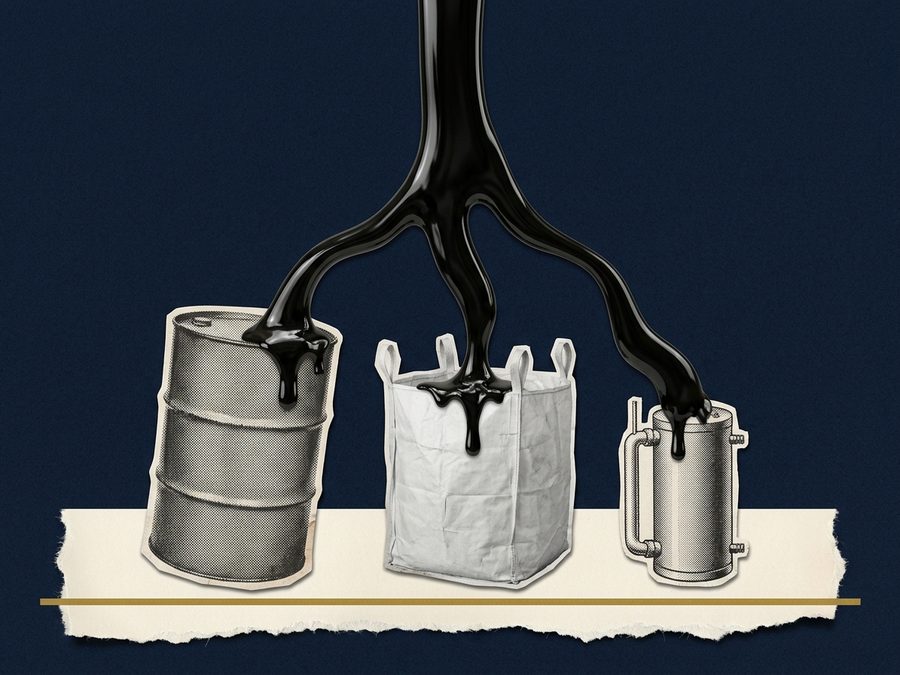
Drummed cargo requires packaging, container capacity, additional handling and a plan for recovering the material. Heated bulk calls for suitable vessels or tankers, temperature control, pumps and storage at destination. Neither option wins in every market. The right choice depends on what the receiving terminal and the final user can actually handle.
That distinction became especially visible during the Gulf shipping disruptions of 2026. As the Financial Times reported in April, interrupted deliveries tightened Indian bitumen supply and drove up costs. For contractors, the consequences reached beyond the commodity market into road-building schedules, project budgets and working capital.
With bitumen, a technically correct purchase can still be a commercially unworkable delivery.
First, establish exactly what is being bought
Bitumen is a dark, adhesive and water-resistant petroleum binder, produced mainly from heavy fractions of crude-oil refining. It softens with heat and becomes more viscous as it cools. That physical behaviour explains much of its transport complexity.
Terminology needs care. In many markets, “asphalt” means the pavement mixture of bitumen and aggregates; in North America, it can also mean the binder itself. A contract should describe the material precisely rather than rely on a term that changes meaning by market.
Grades are not interchangeable labels. Penetration grades such as 60/70 and the commercial designation 80/100 refer to needle-penetration behaviour, commonly tested at 25°C. Lower penetration usually means a harder binder. Crucially, commercial 80/100 should not be assumed to meet ASTM D946/D946M’s 85–100 classification without checking the governing specification.
Viscosity grades such as VG10, VG30 and VG40 follow a different approach, widely used under Indian specifications. Performance grades such as PG 64-22 relate to pavement temperature conditions under ASTM/AASHTO frameworks. Oxidised bitumen used in roofing and industrial products belongs to a separate application category.
A familiar grade name is a starting point—not proof of technical equivalence.
One customs code. Roughly $100 between origins.
QAA Intelligence’s analysis of UN Comtrade data shows an average declared CIF customs value of approximately $533 per tonne for Gulf-origin petroleum bitumen entering India in July 2026. The origin-level averages were about $481 from Oman, $501 from Iran, $539 from Iraq and $581 from the UAE.
All four figures fall under HS 271320, yet they do not describe identical transactions. Customs unit values blend differences in grade, packaging and commercial arrangements, as well as origin. The approximately $100 spread between Oman and the UAE cannot be assigned to any single factor.
These are historical declared import values—not current market offers, refinery quotations or a like-for-like benchmark. To compare two live bids, buyers must separate product specifications, delivery terms, packaging and downstream costs.
For current market coverage and origin-level data, see QAA Intelligence: intelligence.qasralanqaa.com/analysis/bitumen/
Packaging is not an afterthought
The line immediately following the grade on a quotation may be the one that determines whether the deal works: “steel drums”, “jumbo bags” or “heated bulk”. Each option creates a different cost structure and requires a different receiving operation.
Steel drums
Drums travel through conventional packaged-cargo systems and can serve destinations without heated bulk facilities. They also add filling and packaging charges, handling time, container space and possible residue losses. Drum specification, net payload, stacking and unloading arrangements should be confirmed before a price is accepted.
Approved jumbo bags
Purpose-designed large-bag systems may reduce the number of packages handled, but their suitability depends on the grade, bag design, lifting method, storage conditions and the buyer’s ability to recover the solidified product. Not every large bag is suitable for bitumen.
Heated bulk
Bulk removes the cost of individual packages but moves the operational burden to heated tankers, tanks, pumps and controlled transfer. For steady, large-volume movements, it can be efficient where that infrastructure exists. Where it does not, a low quoted freight cost can become an expensive discharge problem.
Specialised tank containers or proprietary solid-packaging systems can provide other options, subject to carrier, terminal and receiving-facility approval. Ordinary liquid flexitanks must not be treated as automatically suitable for hot bitumen.
| Commercial factor | Steel drums | Approved jumbo bags | Heated bulk |
|---|---|---|---|
| Main advantage | Flexible distribution | Fewer, larger packages | Continuous handling at scale |
| Main limitation | Packaging and recovery cost | Compatible lifting and recovery | Heated infrastructure required |
| Destination needs | Unpacking and melting | Controlled unloading and recovery | Storage tanks, heat and pumps |
| Critical risk | Damage and residue loss | Packaging failure | Temperature or discharge failure |
Liquid bitumen is commonly handled at elevated temperatures, often above 140°C depending on grade and viscosity. Overheating, however, can degrade the product and create serious safety hazards. The correct operating window must be established for the specific cargo.
A lower freight quote is not necessarily a lower delivered cost
Consider three offers for the same nominal grade: FCA warehouse, Oman; FOB Sohar, Oman; and CIF Mombasa, Kenya. Their per-tonne prices cannot be compared meaningfully until the buyer identifies where cost and risk move from one party to the other—and what remains outside each quotation.
Under CIF, the seller arranges and pays for carriage and the required insurance to the named destination port, while the risk generally transfers once the goods are loaded on board the vessel. Import clearance, inland transport and final delivery are not automatically included. A route disruption can therefore create unexpected costs without changing the original price label.
For drums delivered to a container carrier before loading on a vessel, FCA will often describe the handover more accurately than FOB. Incoterms® 2020 should be used with a precisely named delivery point, not as a substitute for a full delivery plan.
Quality is a file of evidence, not a grade printed on an invoice
A sound purchase file identifies the governing standard, test methods and acceptance limits. A Technical Data Sheet (TDS) sets out typical or specified properties; a Certificate of Analysis (COA) provides results for the relevant lot or shipment; and a Safety Data Sheet (SDS) explains hazards and safe handling.
Depending on the grade, the technical file may reference ASTM D5 or EN 1426 for penetration, and ASTM D36 or EN 1427 for softening point. Independent inspection can verify the identity, condition and compliance of the cargo before loading.
The name of the grade on a certificate is not enough if the actual test results fall outside the buyer’s agreed limits.
The destination sets the rules
There is no single certificate that makes every bitumen grade acceptable everywhere. European paving materials may be specified under EN 12591; North American projects often apply performance-based ASTM/AASHTO systems. Other jurisdictions, road authorities and projects impose their own requirements.
The buyer and exporter should verify the intended application, governing standard, import or conformity procedures and the customs classification for the actual material. Straight petroleum bitumen is commonly classified under HS 271320; some bituminous mixtures belong under other headings.
Where a profitable transaction comes unstuck
Margin can disappear even when the commodity price looks attractive: a non-compliant specification; damaged drums or unsuitable bags; an unpumpable cargo; a destination terminal without matching equipment; detention and storage after a delay; or documents that disagree on grade, quantity, packaging or routing.
Hot-bulk operations add direct safety exposure, including burns, emissions and potential hydrogen-sulphide hazards. Temperature limits, safe handling procedures and compatible equipment belong in the transaction plan from the start.
Seven questions to ask before requesting a quote
- What exact grade, intended use and governing specification are required?
- Which test methods and acceptance limits will determine compliance?
- Must the cargo arrive in steel drums, approved jumbo bags or heated bulk?
- What net quantity, packaging weight and shipment tolerance are acceptable?
- Can the destination unload, store and use the selected delivery form?
- Which Incoterm and named point apply—and which freight, handling, heating and insurance charges are included?
- Which certificates, inspections and import approvals are required before dispatch?
The final calculation
Bitumen is routinely negotiated as a dollar-per-tonne commodity. That number matters, but it tells only part of the story. The meaningful comparison is the cost of receiving material that meets the specification, clears the required controls and can be used at the destination.
With bitumen, packaging is not simply a shipping detail. It is part of the commercial specification.
Methodology: India figures are declared CIF customs unit values for July 2026, compiled from UN Comtrade by QAA Intelligence. They combine different grades, packaging formats and terms; they are not live quotations. Packaging descriptions indicate general operational trade-offs, not guaranteed savings. Actual payloads, equipment compatibility, safety controls and local regulations must be checked transaction by transaction.
- A grade name such as 80/100 is a starting point; the governing specification, test methods and acceptance limits decide compliance.
- Steel drums, approved jumbo bags and heated bulk create different cost structures and need different equipment at destination.
- Declared customs values for Gulf bitumen into India are historical averages, not live offers or a like-for-like benchmark.
- FCA, FOB and CIF quotes cannot be compared until the point where cost and risk transfer, and what each excludes, is clear.

Amit Tata
International Sales Manager, Qasr Al Anqaa · Specialist Writer on Commodities & Trade
He writes on commodity supply chains, trade finance and market access for CARAVAN.
Sources & References
Sources the figures in this article are attributed to.
- Asphalt Institute & Eurobitume — The Bitumen Industry: A Global Perspective, 4th ed. (IS-230) — 2024For: bitumen properties, production and terminology
- ASTM International — ASTM D946/D946M and ASTM D6373; associated ASTM/EN testing standardsFor: penetration and performance grades; test methods
- QAA Intelligence — Bitumen Price Today & Middle East Market Analysis; UN Comtrade import records for India — 25 October 2026; July 2026For: declared CIF customs unit values of Gulf-origin bitumen entering India
- International Chamber of Commerce — Incoterms® 2020For: FCA, FOB and CIF delivery, cost and risk
- Asphalt Institute — Health, safety and environmental guidance for bitumen handlingFor: handling temperatures and hot-bulk safety
- Financial Times — Alarm Spreads Among Road-Builders as Iran War Bitumen Shortage Bites — April 2026For: Indian bitumen supply and costs during the 2026 Gulf shipping disruptions