
CARAVAN – Volume 1 | Issue 08
October 13, 2026 · Dubai
A signed contract and an agreed price do not deliver the goods. Between purchase and arrival lies the work that rarely makes the headlines: verifying suppliers, coordinating production, arranging inspections, aligning payments, preparing documents and moving goods across borders. Issue 08 of CARAVAN examines what happens after the deal is made, and the decisions, responsibilities and overlooked details that determine whether an order becomes a successful delivery.
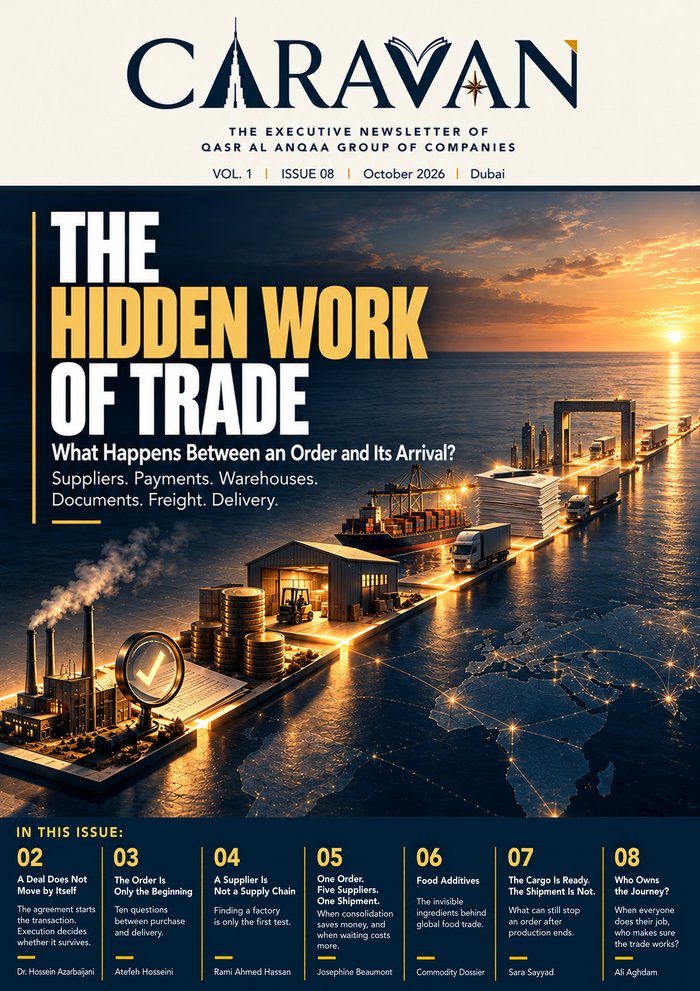
Inside This Issue
- 01 — A deal does not move by itself.
An agreed price, a signed contract and a confirmed order are not enough to get goods moving. Production, inspection, payment, documentation and transport must work together. Even when every party fulfils its individual responsibilities, the transaction can stall if nobody manages the connections between them. - 02 — Finding a supplier is only the first test.
A competitive quotation does not establish whether a factory can fulfil a particular order. Supplier identity, manufacturing capability, product specifications and available production capacity all need verification before a sourcing decision can be considered reliable. - 03 — One shipment is not always cheaper than several.
Cargo consolidation can reduce freight costs, but waiting for the last supplier may introduce storage charges, financing costs and missed sales opportunities. The real calculation is not simply the number of containers shipped, but the total commercial cost of getting the goods to market. - 04 — Small ingredients can carry significant supply risks.
Food additives may represent only a fraction of a finished product, yet an unsuitable grade or delayed delivery can interrupt an entire production run. Their global trade depends on product-specific sourcing markets, technical specifications, quality requirements and regulatory compliance. - 05 — Cargo readiness is not shipment readiness.
Finished production does not necessarily mean goods can leave the factory. Payment conditions, freight bookings, commercial documents, customs requirements and destination arrangements must be aligned. A shipment moves only when the necessary steps are complete and the parties responsible for them are ready.
What's Inside Issue 08
Read the Lead Articles
Six perspectives on the decisions, risks and responsibilities that shape international trade beyond the commercial agreement.





Download CARAVAN Issue 08 PDF
The complete October 2026 edition: supplier assessment, trade execution, cargo consolidation, payments, documentation and a food additives dossier in one document.
⭳ Download Full PDF