
The Global Meat Market in 2026: A Closer Look
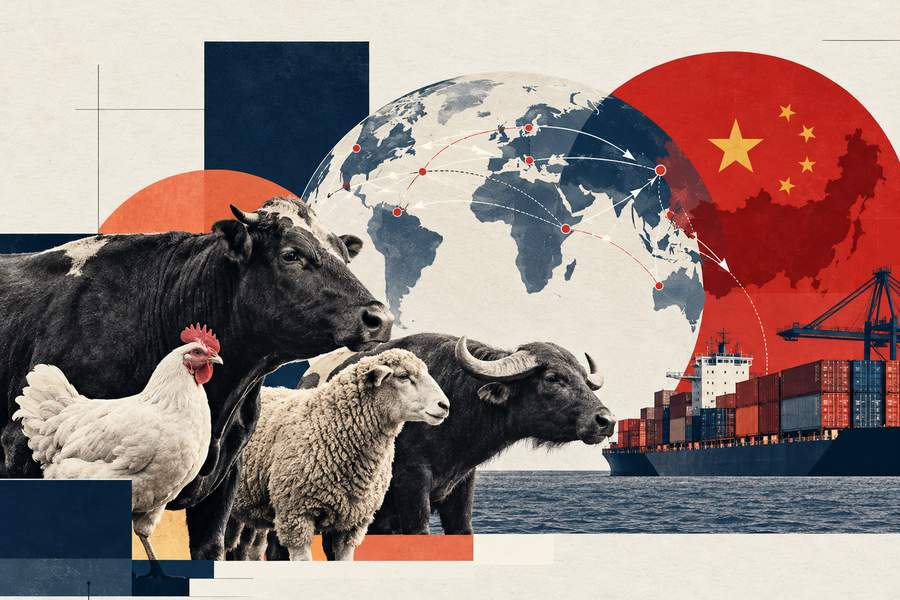
Meat doesn’t behave like one market — it behaves like four markets wearing the same label. Beef output is contracting for the first time in years on the back of the smallest US cattle herd since 1951, poultry is the only major protein still expanding, and a 55% Chinese tariff on over-quota beef imports, effective January 2026, has redrawn who sells beef to whom. This dossier walks through production, trade routes, certification and the three risks — disease, trade policy and feed costs — that matter most for anyone holding meat exposure into 2026.
Meat doesn’t behave like one market. It behaves like four markets wearing the same label.
Beef, poultry, sheep meat and buffalo meat each move on different supply cycles, different trade routes and — as 2026 has made clear — different political risk. A trader who reads “meat prices” as a single number is already a step behind. The more useful question, this year especially, is which meat, from where, to whom, and under what rules.
Production: One Category Is Shrinking, One Is the Only Thing Still Growing
USDA’s livestock outlook puts global beef output at a record 62.2 million tonnes in 2025, with the 2026 forecast lower — around 61 million tonnes, a pullback of roughly 2 percent. That’s not a rounding error; it’s the first meaningful contraction in years, and it traces back to a single, blunt fact: USDA’s January 2026 Cattle Inventory report put the US cattle herd at 86.2 million head, the lowest count since 1951, with the smallest calf crop since 1941. Herds don’t rebuild in a quarter. This is a multi-year supply story, not a seasonal one.
The United States remains the largest beef producer at roughly 12.3 million tonnes, with Brazil close behind at 11.9–12.6 million tonnes, followed by China, the EU, Argentina and Australia. But production leadership and export leadership aren’t the same thing — the US eats most of what it produces. Brazil, sitting on the export side of that equation, is choosing to trim output by 5–6 percent even while posting record exports, a sign that external demand is currently worth more to Brazilian producers than domestic volume.
Poultry tells the opposite story. USDA data show world output climbing from 104.4 million tonnes in 2024 to 108.0 million in 2025, with the 2026 forecast pointing to 110.7 million — up 3 percent, and the only major protein category still expanding production at all. China and Brazil lead, each around 15–17 million tonnes, with the US close behind. When every other protein is tightening, poultry is where supply is still saying yes.
Sheep, goat and buffalo meat are harder to pin down with the same precision — neither category gets the same statistical attention as beef and poultry. FAO figures put China at roughly 5.1–5.2 million tonnes of sheep and goat output (31 percent of a 16.4–16.6 million tonne world total), with India and Pakistan behind it. Buffalo meat is essentially India’s story: 4.35 million tonnes against Pakistan’s distant 1.19 million, out of a 6.9 million tonne global total. The freshest available figures for both categories date to 2021–2022 — a genuine data gap worth flagging to anyone trading on these numbers.
Trade: China Just Rewrote the Beef Map
If there’s one fact that matters more than any other in 2026, it’s this: China’s Ministry of Commerce imposed a 55 percent tariff on beef imports above its quota, effective January 1, 2026, on a quota fixed at 2.7 million tonnes. China is still the world’s largest beef importer, at roughly 3.8 million tonnes — but the tariff has cut Brazil’s and Australia’s effective access below what they were actually shipping in 2025. Argentina, still operating comfortably inside the new terms, is reported to be picking up the difference. Its 2026 exports are already running 7 percent ahead of last year, hitting 810,000 tonnes.
This is a policy shift with a familiar shape: a tariff regime reshaping not the product but the economics around it. Beef is now living that lesson in real time. Brazil remains the largest beef exporter by volume (4.0–4.3 million tonnes), Australia second (2.2 million), India’s buffalo-heavy exports third (1.6 million) — but which buyer actually clears at what price now depends on a quota line drawn in Beijing.
Sheep meat is a quieter but equally telling story. Meat & Livestock Australia data show Australia dominating exports — over A$4 billion in value, 363,000 tonnes in FY2024–25 — and the demand growth is coming almost entirely from the Gulf: Saudi Arabia’s imports rose 25 percent year-on-year, Qatar’s 30 percent, and India’s lamb purchases from Australia jumped 124 percent. China, meanwhile, is trading down — fresh lamb volumes fell 9 percent even as cheaper mutton cuts rose 18 percent, a visible shift in Chinese household spending.
Poultry’s export order is more settled: USDA figures put Brazil at 30–36 percent of the global market, the US at 22 percent, the EU at 13 percent, and Thailand at 9 percent — concentrated specifically in processed and cooked chicken. What’s new is where Brazilian halal chicken is finding its fastest growth: Saudi Arabia, the UAE, Mexico and Singapore led 2025’s gains.
And then there’s India’s buffalo meat trade, which is simply outrunning every other protein category on the page. APEDA (India’s Agricultural and Processed Food Products Export Development Authority) puts exports at $5.1 billion in FY2025–26, up 25.6 percent, with officials projecting more than $6 billion for the year ahead. The first quarter of FY2026–27 alone brought in $1.5 billion — up 66.6 percent year-on-year. Vietnam, Egypt, Malaysia, the UAE and Saudi Arabia remain the anchor markets, but Iraq is the number worth watching: imports there grew roughly 99.5 percent year-on-year, to $740 million.
What It Actually Takes to Move Meat Across a Border
None of this trade happens without a working cold chain and the right paperwork, and both have gotten more demanding, not less.
The temperature discipline is unforgiving and largely non-negotiable: frozen meat at or below −18°C, chilled red meat at or below +7°C, chilled poultry at or below +4°C. Almost all of it now moves in standard reefer containers rather than dedicated reefer vessels — 40-foot high-cube reefers alone carry more than 90 percent of global reefer container volume.
Certification is where the real friction sits. Veterinary health certificates follow the WOAH (OIE) framework, but market access into the UAE, Saudi Arabia and China specifically requires plant-level establishment approval — not just a country-level clearance. Halal certification adds another layer entirely: Islamic slaughter certification from a recognized body, ESMA and Dubai Municipality in the UAE, SFDA-approved certifiers in Saudi Arabia.
That layer is actively tightening. Saudi Arabia’s SFDA expanded halal certification requirements to composite foods containing any meat-derived ingredient in March 2025. A draft GCC-wide halal standard closed its public comment period in April 2026 and has not yet been finalized — worth watching, since a harmonized GCC standard would change compliance costs across every Gulf import corridor at once. India, on the exporting side, expanded its own halal export certification system from 15 to 35 countries in April 2026.
Shipping itself isn’t immune to geopolitics either. Iran-related risk through the Strait of Hormuz has pushed a portion of Brazil’s Middle East-bound cargo away from the Suez corridor toward the Cape of Good Hope in 2025–26 — adding cost and time to routes that used to be straightforward.
The Risk List for 2026
Prices are already moving on the back of tightening supply. USDA AMS data put US fed steer prices at $240–242/cwt, up 7–8 percent year-on-year and briefly touching a record $246.91/cwt in late February. Meat & Livestock Australia figures show Australian lamb hitting an all-time high of $11–12/kg dressed weight in March. These aren’t abstractions — they’re the direct output of the herd contraction and demand shifts described above.
Three risks sit above the rest for anyone holding meat exposure into 2026.
Disease. Per WOAH (World Organisation for Animal Health) outbreak reporting, a novel SAT-1 strain of foot-and-mouth disease has appeared in China’s Gansu and Xinjiang provinces — 6,229 cattle affected, over half of young cattle exposed not surviving. Separately, USDA APHIS data show H5N1 avian influenza now confirmed on every continent, with more than 180 million US birds affected and the first cattle case recorded in the EU, in the Netherlands.
Trade policy. China’s beef tariff is the clearest example on the board right now, but it’s a pattern, not an isolated event — the same dynamic playing out this year across urea, sulphur and sugar applies just as directly to protein.
Feed costs — genuinely unresolved. Some current CBOT corn futures readings put the price as high as $4.40/bushel, directly contradicting earlier USDA WASDE guidance that pointed toward lower feed costs. This one is worth watching rather than trading on; the signal isn’t clean yet.
Four different meats, four different supply stories, and one shared lesson: in 2026, the binding constraint on where meat goes is less about who can produce it, and more about who can clear the certification, absorb the tariff, and keep the cold chain intact from farm to market. That is precisely the layer where a trading house with regional relationships — not just a supplier with volume — earns its margin.
- Global beef output is contracting for the first time in years (62.2M tonnes in 2025 to ~61M forecast for 2026) on the smallest US cattle herd since 1951, while poultry is the only major protein still growing production (+3% forecast for 2026).
- China's 55% tariff on over-quota beef imports, effective January 2026, has redrawn global beef trade flows — cutting Brazil's and Australia's effective access while Argentina's exports run 7% ahead of last year at 810,000 tonnes.
- Certification, not just supply, increasingly decides who can trade: plant-level approval for UAE/Saudi/China access, tightening halal certification requirements across the Gulf, and three live risks — disease, trade policy and unresolved feed costs — sit above the market into 2026.

Dr. Hossein Azarbaijani
CEO & Founder, Qasr Al Anqaa Group of Companies · PhD in Cognitive Science & Market Studies
He writes for CARAVAN on global trade strategy, market structure and the decisions behind cross-border deals.
Following this market for a purchase or sale? QAA Commodity Advisory publishes commodity market analysis, signals and an outlook every two weeks; live prices are free in the meat market analysis.
Sources & References
Sources the figures in this article are attributed to.
- U.S. Department of Agriculture (USDA) — Livestock outlookFor: global beef output
- U.S. Department of Agriculture (USDA) — USDA data and figuresFor: world poultry output; poultry export shares
- U.S. Department of Agriculture (USDA) — Cattle Inventory report — January 2026For: size of the US cattle herd
- USDA Agricultural Marketing Service (AMS) — AMS dataFor: US fed steer prices
- USDA Animal and Plant Health Inspection Service (APHIS) — APHIS dataFor: confirmed H5N1 avian influenza cases
- U.S. Department of Agriculture (USDA) — WASDE guidanceFor: feed-cost outlook
- Food and Agriculture Organization of the United Nations (FAO) — FAO figuresFor: figures for China